
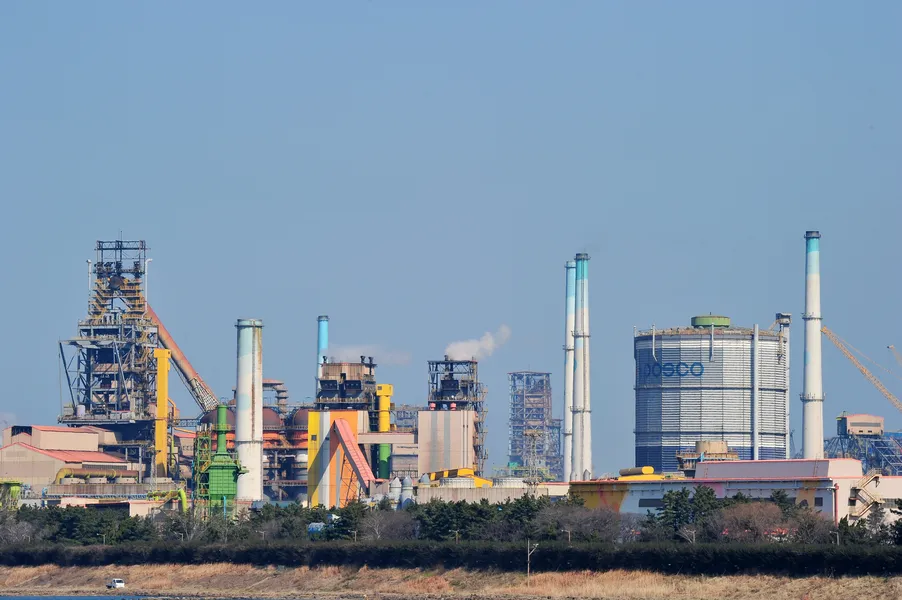
Background
POSCO Pohang Steelworks is a leading company in industrial safety that introduced its own safety locking framework, ILS (Isolation Locking System), as early as 2006, long before the LOTO concept became firmly established in Korea. Since then, the company has continuously improved and advanced this system for more than 18 years.
This project was carried out as part of the industrial safety innovation platform program for FINEX Plant No. 3 at Pohang Steelworks.
At FINEX Plant No. 3, a Running ILS system was already in operation to control unauthorized worker entry into hazardous equipment areas and restricted zones. However, as the limitations of the conventional manual key-based method became increasingly evident, Smart ILS was introduced to reinforce the system and transition it to a digital operating model.
Challenges
During the project, three major barriers emerged.
First — Extreme environment
The most fundamental issue at FINEX Plant No. 3 was the operating environment itself. High-density dust generated by the process and heavy steam released from the water treatment facilities created conditions so harsh that not only smart locks but even conventional manual key locks could not survive beyond one to two months. Regardless of the lock type, the project could not move forward without first addressing durability.
Second — User change management
For workers who had used physical keys for decades, telling them to “open and close locks with a smartphone app from now on” was not a simple tool change. It required a change in work habits themselves, from receiving keys through an app to unlocking and locking through the app. Close field support and hands-on training became critical tasks in this transition.
Third — Communication instability (identified after deployment)
The third challenge was not fully anticipated at the beginning; it only became visible during actual operation. In some areas, the private LTE network was unstable, causing interruptions in communication with the server. In other areas, electromagnetic noise generated by operating equipment caused the Bluetooth signal itself between the smartphone and the smart lock to be lost. Because this was the first attempt to apply Smart ILS to the steel industry, many other unexpected issues, both large and small, also emerged during infrastructure deployment.
Efforts to Solve the Problems
To address these three challenges, the following approach was taken.
A POSCO-optimized Smart ILS solution was separately configured based on BLE smart locks from NOKE, USA, and adapted for the POSCO operating environment.
To ensure stable lock operation even in communication shadow areas or in high-noise equipment environments, we independently developed and applied an offline operating policy that allowed keys to be used without an internet connection. This created a structure in which field work would not stop even when the network was unavailable.
The extreme environment issue was addressed by installing custom protective covers on the locks.
Although this was not a perfect solution, it proved effective in extending the actual service life of the locks to a meaningful degree.
Results
This project resolved several chronic issues associated with the conventional manual key-based Running ILS operation at once.
The long-standing key management problem—having to track who had dozens of physical keys and whether they had been returned—was eliminated. Manually written access logs were replaced by digital automatic records. The problem of users informally handing over issued keys to others also became structurally impossible under the system.
Above all, the greatest significance of this project was that it practically demonstrated the possibility of real-time monitoring across the entire Running ILS process. Through the integrated safety control system, the administrator screen shows in real time who unlocked or locked which lock, in which area, and at what time.
Because it verified the practical viability of Smart ILS under the harshest conditions of a steel plant environment, this project can be regarded as a foundation case for smart safety management in Korea’s heavy industry sector.
© Jiwootech Co., Ltd. — This case study is based on actual field operating experience.