
Background
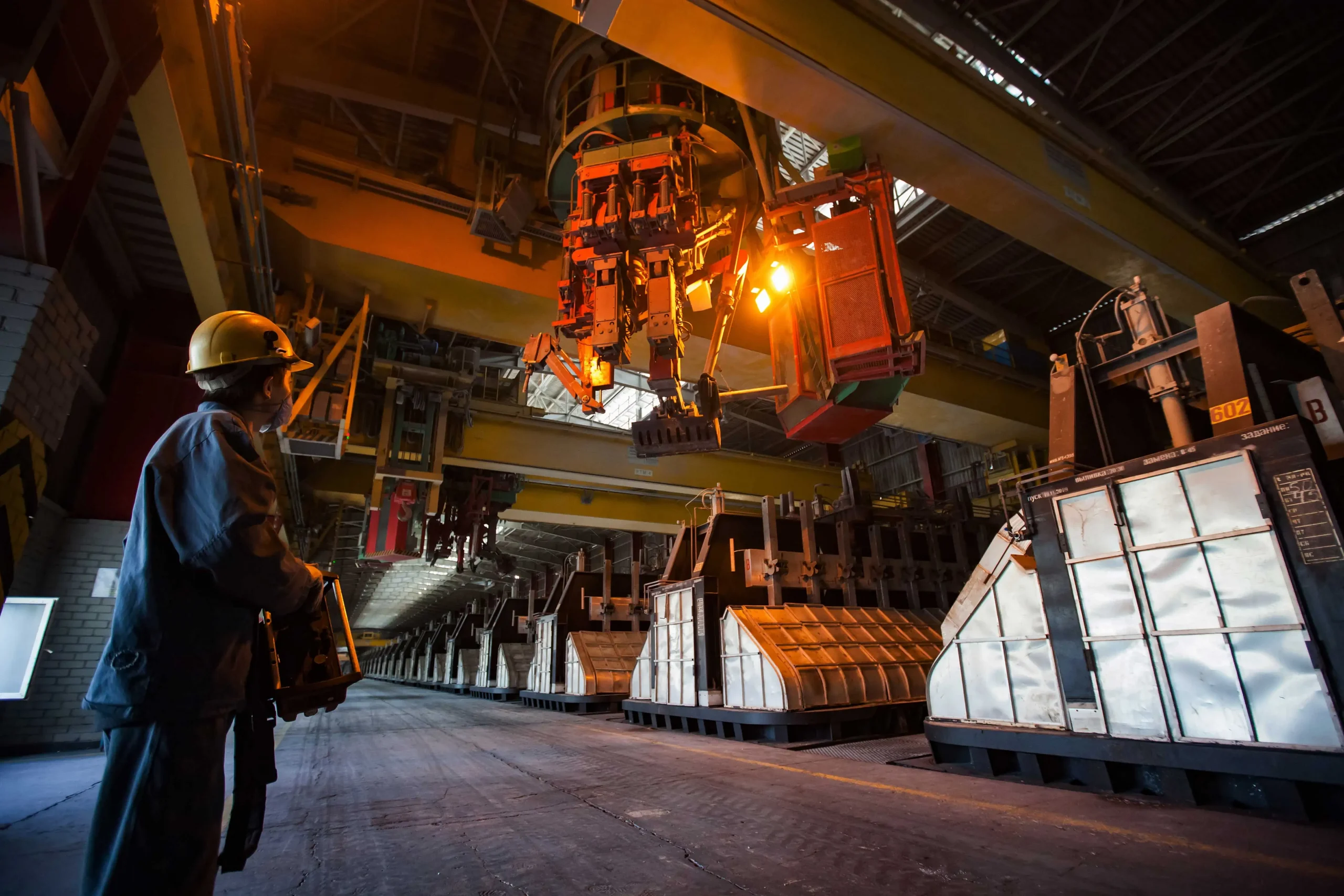
Thousands of overhead cranes are operated at POSCO Pohang Steelworks.
As automation has advanced, most cranes are now operated by workers using remote controllers.
For major cranes, two remote controllers are used together: a primary remote and a secondary remote. Under operating rules, when one remote is in use, the other must never be used.
However, near-miss incidents had continued to occur in the field.
For example, while Worker A is operating a crane with the primary remote, Worker B, unaware of this from a distance, may assume the crane is stopped and attempt to operate the same crane with the secondary remote. This situation, in which two people simultaneously control one crane, can lead to a serious safety accident.
Challenges
This project had two core challenges.
The first, and essential, challenge was to enforce control so that when one remote controller was in use, the other remote could not be physically taken out. Rules and training alone had clear limits, so the system itself had to prevent this automatically.
The second challenge was to provide a practical method for transferring remote control authority on site from current user A to standby user B during planned maintenance shutdown periods, when multiple crane operators wait and rotate by time slot.
Solution
The first step was to identify the cranes to be managed and establish an operating rule under which each crane remote controller would be stored in a separately fabricated cabinet. Each cabinet was then fitted with a smart lock and managed through the Smart ILS system.
From a technical perspective, the design was established as follows. The crane was the managed asset, but the actual locking object was the cabinet and its smart lock. Therefore, each cabinet was assigned an ILS ID subordinate to its crane. Where one crane had multiple cabinets, a lock group ID was defined to bind them together.
The core technology applied here was the Exclusive Lock Policy. Under this policy, when an authorized user unlocks one lock within the group, the other locks cannot be unlocked until the first unlocked lock is locked again. In other words, the system structurally blocks simultaneous use of the two remote controllers.
(The user-to-user authority handover function remains at the planning stage only, because of the many variables in actual field operation.)
Results
This project produced meaningful results for both our company and Pohang Steelworks.
Safety incidents were significantly reduced.
Although it took some time after deployment for the system to stabilize, field operations later reported that safety incidents had decreased markedly.
It also achieved significant scale.
As the system was expanded across cranes throughout Pohang Steelworks, approximately 1,500 POSCO direct employees and about 8,000 contractor users are now using the Smart ILS system.
It became the first field application of the Exclusive Lock Policy.
This policy can be used effectively not only for crane remote controller management but also in many other access control situations. For example, during periodic inspection or repair of an overhead crane, if there are two access routes, two teams entering simultaneously from opposite directions can create hazards for one another. With the Exclusive Lock Policy applied, when one side is already inside, the opposite access route cannot be opened, fundamentally eliminating that risk.
The Question This Project Left Behind — At the Boundary Between IT and OT
As this project progressed, it led us to think beyond simple technical implementation and reconsider the relationship between IT (Information Technology) and OT (Operational Technology) in industrial enterprises.
When introducing a system where IT and OT intersect, such as Smart ILS, many companies do not yet have clear answers to the following four questions:
◌ Is the project owned by the IT department or the OT department?
◌ Which department bears the investment cost for servers, software, locking devices, and auxiliary equipment?
◌ Who is responsible for system operation?
◌ Who pays for the software used by contractor personnel?
Another question is whether Smart ILS operations can be divided into IT
(ILSS/KMS, DB, web console, mobile app) and OT
(smart locks, P-ECD, field installation), with two separate suppliers each taking responsibility for their own scope and operating them separately.
(We plan to present our view on this point under a separate topic.)
There is no single predetermined answer. However, if these criteria are not defined in advance, unexpected confusion can arise during implementation. For companies considering Smart ILS adoption, we recommend reaching internal agreement on these questions before making technology decisions.
© Jiwootech Co., Ltd. — This case study is based on actual field operating experience