
Smart ILS
That Makes Safety Procedures Work in the Field
From access control for hazard zones around operating equipment to isolation, lockout, verification,
and recordkeeping for shut-down equipment, Smart ILS connects approvals, authorizations, lock control, and evidence in one operating framework.
It helps ensure that isolation plans established through risk assessment are carried out consistently in the field,
and every step is captured in an automatic Audit Log for audits, incident investigation, and continuous improvement.
What is LOTO?
Lockout/Tagout (LOTO) is a foundational safety procedure used during maintenance, inspection, and service work to prevent injuries caused by unexpected startup or the release of stored energy.
It protects workers by isolating electrical, mechanical, pressure, hydraulic, pneumatic, thermal, and other hazardous energy sources, then clearly indicating that work is in progress through lockout and tagout.
In large-scale manufacturing and continuous-process industries, LOTO is more than a compliance requirement; it is an essential operating standard for maintaining on-site safety and equipment reliability.
Why Is LOTO Important?
◌ It prevents injuries caused by unexpected equipment startup.
◌ It reduces electric shock, entanglement, crushing, and release incidents caused by stored energy.
◌ It is the minimum safety standard for protecting workers’ lives.
◌ It is directly tied to compliance with occupational safety regulations and company safety rules.
A proper LOTO procedure is a basic condition that allows workers to perform maintenance and inspection work with confidence.

LOTO Is the Core Execution Step in the Overall Industrial Safety Workflow
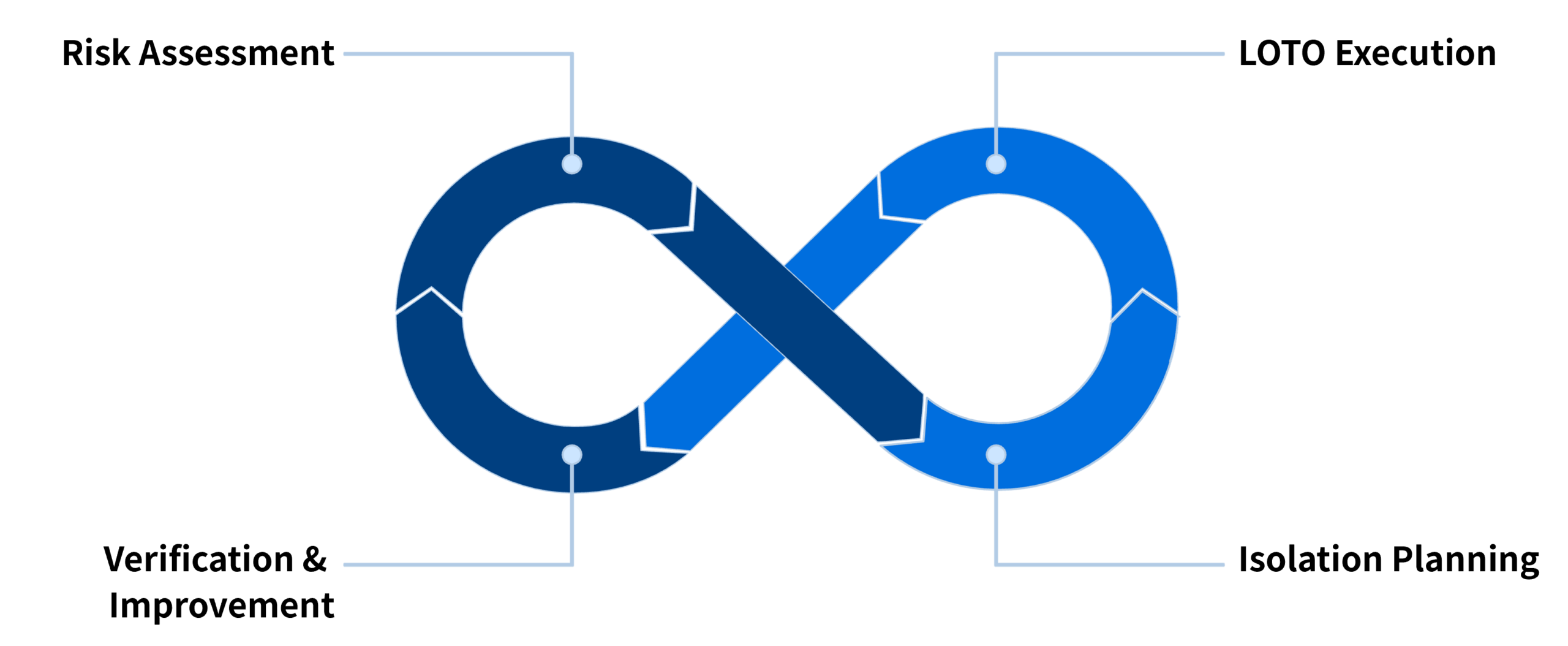
LOTO is not a standalone procedure. It must operate within the full safety workflow: Risk Assessment → Isolation Planning → Permit to Work (PTW) → Execution (LOTO) → Verification and Return to Service → Records and Improvement.
Smart ILS is not designed to manage only the execution step in isolation. Its purpose is to keep planning, approval, field execution, and evidence connected without gaps.

Why LOTO Breaks Down in the Field
The problem is not only a lack of procedural knowledge. Field safety becomes unstable when definition and execution, approval and authorization, and locking and evidence are disconnected.
If the criteria are not clear on which equipment must be isolated and how far the isolation must extend, each worker may interpret it differently, and work may proceed with only part of the energy sources isolated.
This is especially common in sites with complex equipment or multiple connected systems. Questions such as “Does this valve need to be included?” or “Is this breaker also part of the isolation scope?” may be answered differently by different people, leading to missed isolation points or excessive isolation.
[ Approach ]
The criteria for isolation targets (Assets) and lock points must be standardized so that the same scope can be confirmed before work begins.
In the field, the most common issue is, “Where exactly must this be locked?”
When there are multiple breakers, valves, switches, doors, or local control points, workers may identify different lock points.
As a result, the lock may be applied but the critical point may be missed. In other cases, unnecessary points may be locked, causing confusion.
[ Approach ]
Lock points should be managed by ID and shown together with location, photo, drawing, and equipment information so that every worker can identify the same point.
If it is unclear who requests, who approves, and who can lock or unlock, the procedure easily becomes formal only, and responsibility becomes unclear.
This risk grows when multiple departments, contractors, and work teams are involved. Unclear roles can lead to informal handling, bypassing, and disputes after the fact.
[ Approach ]
Role-based access control (RBAC) and workflow must be clearly defined so that responsibility for request, approval, execution, lock, and unlock is clear.
Paper records or verbal reports alone make it hard to confirm later what was actually done in the field.
If questions such as “Were all lock points verified?” or “Who removed the lock, and when?” cannot be answered objectively, audits and incident investigations will be delayed.
Doing the procedure and proving it are not the same.
[ Approach ]
An Audit Log should record, show, and monitor who did what, and when.
When several work teams enter the same work area at the same time, it becomes hard to know who is still in the field, who can perform the final unlock, and whether every team has finished the job.
In this case, individual confirmation alone is not enough. Team presence and final release conditions must also be controlled.
[ Approach ]
The system should manage worker and team presence, group lock conditions, and final unlock conditions together.
LOTO is not completed by procedure alone.
It becomes effective in the field only when standards, approval, execution, verification, and evidence are connected in one flow.
Smart ILS Improves Execution Quality in the Field
Smart ILS standardizes isolation criteria and connects approval, authorization, lock, unlock, and records in one flow.
It reflects field conditions that are often missed with paper-based control and physical padlocks alone, helping the procedure work in practice.
Standardized Isolation Criteria
It applies clear system-based criteria for how far isolation must extend, reducing site-by-site interpretation and supporting the same operating principle across the field.
Clear Lock and Unlock Conditions
It makes clear what must be locked and under what conditions it can be unlocked, reducing errors caused by carelessness or individual judgment.
Authorization and Approval Control (RBAC)
With role-based access control (RBAC), it separates the responsibilities of approvers, supervisors, and workers, and reduces unauthorized handling.
Smart Lock Status-Based Control
By linking with smart locks, it can verify lock status and restrict the next step when required conditions are not met.
Extended Control with VLock
It supports team-based control such as worker presence, group lock conditions, and final unlock conditions in multi-team work.
Automatic Audit Log
Key actions such as lock, unlock, approval, and verification are recorded automatically and can be used for audits, incident investigation, and corrective improvement.

It does not rely only on individual attention to prevent bypasses and mistakes.
Approval and records remain naturally within the procedure.
Smart ILS takes LOTO execution in the field to the next level.
Benefits of Smart ILS
Smart ILS turns procedures into a digital execution system and improves field control, evidence quality, and operating speed.
After deployment, the improvement can be measured and refined through clear performance indicators.
Reduced Bypass and Unauthorized Handling
It supports work based on approved procedures and lock criteria, helping reduce informal handling and missed steps.

Faster Response for Audits and Incident Investigations
With automatic logs and history management, it is easier to confirm who did what and when, reducing the time needed for audits and investigations.

Improved Field Efficiency
By managing isolation targets, lock points, and approval steps in a structured way, it reduces field confusion and helps stabilize both job preparation and job completion.
Lower Risk of Incidents and Disputes
Based on standardized procedures and automatic records, it improves execution quality and reduces risk caused by incorrect judgment before and after work.
Key Features of Smart ILS
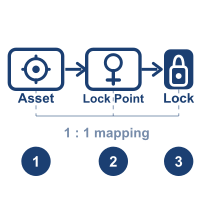
Consistent control from isolation target to lock point
Connect equipment, energy sources, and lock points so users can clearly see and manage what must be locked and how.
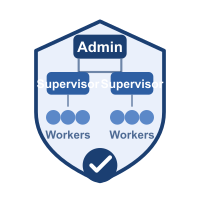
Policy-based safety management
Apply work approval, roles, sequence, and exception rules as system policies to reduce site variation and keep execution consistent.
All Ready, All Safe
The next step proceeds only when safety conditions are met, including worker clearance, approval status, and lock status.
FFAQ – Frequently Asked Questions
Basic operation is possible with paper procedures alone.
In actual field work, however, problems such as missed approvals, confusion over lock points, multi-worker control issues, and missing records tend to repeat.
Smart ILS is needed to standardize these field variables, keep clear records of who did what, and improve execution quality.
It is controlled by checking each worker’s authorization, approval status, lock conditions, and field presence together.
When needed, policies such as group lock, sequential unlock, and final unlock conditions can be applied to reduce the risk of unauthorized unlock.
Smart ILS is designed with field conditions in mind and can support offline or limited-connectivity environments.
The deployment method can be configured to match the customer’s security policy and operating scenario.
Field operation needs backup procedures for these exception cases.
Depending on the customer’s operating rules, management procedures, alternative methods, and supervisor approval steps can be defined together.
Logs and reports can be provided based on key events such as lock, unlock, approval, verification, and work history.
These records show who did what, and when.
Accidents do not start from the lock itself. They start from missed execution.
Standardize the procedure with Smart ILS and build a field operation system where approval and evidence are captured automatically.
We design the implementation scenario together, aligned with the deployment scope (plant, process, equipment) and on-site policies.