
SMART ILS
Establishing LOTO as a Standard Process in the Field
It connects isolation targets, lock points, approval and authorization, lock and unlock, and automatic logs in one operating flow.
‖ What is Smart ILS?
It helps ensure field execution follows the standard process without omission.
Smart ILS is a process-based system designed to make LOTO work in the field, not just in documents or training.
Workers are guided step by step on what to do next, and managers can consistently control whether the procedure is being followed without gaps.
It structures isolation targets and lock points to make “target-to-lock” clear.
It organizes equipment, energy sources, and isolation points in a structured way, and links each point to an actual locking device.
As a result, each job clearly shows what must be isolated and what must be locked, reducing field-level interpretation gaps and mistakes.
It turns procedure into an operating rule through authorization and approval (RBAC).
With role-based access control (RBAC) and approval workflow, unauthorized execution or unlock is structurally prevented.
Even exceptions are handled by policy and records, not by personal judgment alone.
With VLock, unlock and restore are restricted until “ALL SAFE.”
Job completion and equipment restoration are the stages where incidents often occur.
VLock restricts UNLOCK and RESTORE until ALL SAFE is confirmed, including zero remaining personnel in the field.
Automatic Audit Logs support both evidence and improvement.
The system automatically records who did what, when, and with what authority.
These records support audits and incident investigations, and also help identify recurring issues for procedure improvement and CAPA.
‖ Background and Current Status of Smart ILS
Smart ILS began in 2021 with Korea’s first field application of running-equipment ILS and has evolved by addressing risks repeatedly identified in actual operations.
In the early stage, the limits of physical key control and paper-based register management became clear. The focus then shifted to a system-based control model.
Later, role-based access control (RBAC) and approval workflows were added to reduce misuse of authority and unauthorized handling. Field deployment and validation were repeated to build a practical operating model.
Today, Smart ILS is evolving into a Korean end-to-end LOTO execution solution that connects master data, execution, verification, and records in line with OSHA intent and occupational safety requirements.
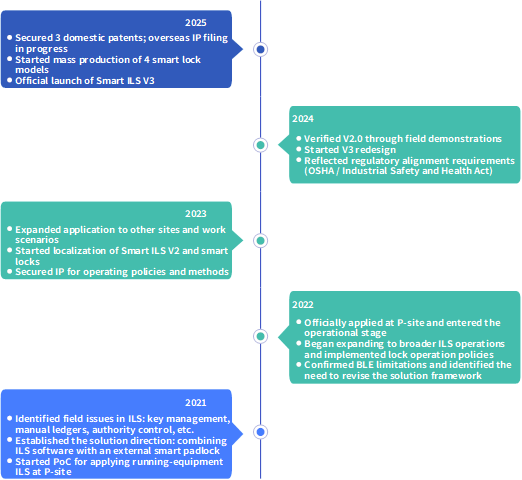
The roadmap to v3 reflects a step-by-step response to issues identified in real field operation.
‖ Key Features of Smart ILS
The core function of Smart ILS is to connect the full process in one flow, from isolation master data and lock mapping to work execution such as approval, lock, verification, and unlock.
With role-based access control (RBAC) and operating policies, it structurally reduces unauthorized actions and informal handling. VLock also restricts restore before ALL SAFE is confirmed, lowering risk in the final restore stage.
All activities are recorded through automatic logs and reports, supporting audits, incident investigation, and CAPA.
Master Data Management (Isolation Targets)
Manages equipment, energy sources, and isolation points in a standard structure so it is clear what must be isolated. (Zone, Facility, Machinery, Process, Pipeline, etc.)
LOTO Workflow Execution
Provides a step-by-step flow from request and approval to lock/unlock, verification, and close-out, so the procedure is carried out without omission.
Role-Based Access Control (RBAC) and Approval Control
Structurally blocks unauthorized lock, unlock, and approval, and makes responsibility and control scope clear.
VLock (Virtual Lock)
Restricts unlock and restore until zero remaining personnel (ALL SAFE) is confirmed, reducing risk in the final restore stage.
Lock Point–Lock Mapping
Links each isolation point to locks, hasps, and tags so each job can manage where to lock and what to verify in a consistent way.
The mapping structure and operating method can also be separated for running-equipment ILS and shut-down ILS.
Integrated Management of Users, Organizations, and Contractors
Manages all LOTO-related users in one system, including direct employees, contractors, and resident personnel.
User roles, permissions, and organizational relationships can also be managed together.
Lock Operation Policy (Key/Lock Lifecycle)
Standardizes the full lock lifecycle by policy, including issuance, return, validity period, loss, disposal, and exceptions, helping reduce large-scale operational risk.
Audit Log and Reports
Automatically records and tracks who did what and when, supporting audits, incident investigation, and CAPA.
‖ Solution System Architecture
Smart ILS is an end-to-end operating system that connects the field layer (mobile app and locks) with the server layer (authorization, policy, and logs), so LOTO execution, control, and evidence stay connected.
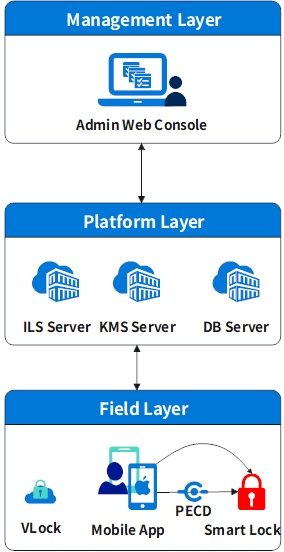
- KMS (Key Manager Server): manages lock operations such as lock/key registration, issuance, and return.
- ILS Server: manages master data, workflow status, and the sequence of request, approval, lock, verification, unlock, and completion while validating authority and policy.
- Web Admin Console: configures and manages operating standards such as isolation assets, policies, users, and reports.
- Mobile App (Android/iOS): supports field execution such as lock, unlock, and verification, with offline support when needed.
- Smart Lock: performs physical locking at isolation points and is controlled according to policy.
- VLock: restricts UNLOCK/RESTORE until ALL SAFE is confirmed, reducing restoration risk.
- Optional Integration: can be linked with existing systems such as PTW/Work Order, MRP, CRM, safety monitoring systems, contractor management systems, EAM/ERP, and SSO to improve operational efficiency.
‖ Deployment Guidelines
Deploying Smart ILS is not just a system installation project. It is a change management project to establish one LOTO operating model for both direct employees and contractors.
In the early stage, the key is not to apply every function at once. The priority is to give users a quick success experience in the field. Once users see that it works in practice, adoption can spread more naturally across the organization. For this reason, Smart ILS recommends starting with running-equipment ILS, where policy is simpler and field impact can be confirmed quickly.
After stabilizing execution, control, and records in running-equipment ILS, shut-down procedures and wider deployment can be expanded step by step under the same operating principles.
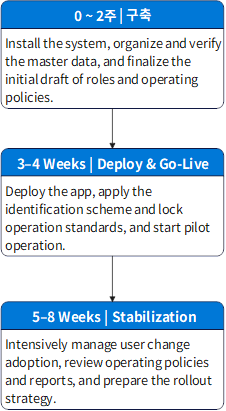
For PoC, a cloud environment is recommended by default to reduce schedule and infrastructure burden. On-premise deployment can be reviewed separately based on the customer’s security policy and network environment.
In the end, success depends less on technology and more on user change management across both direct employees and contractors, including roles, approval rules, and work habits. In general, Smart ILS recommends 3 to 6 weeks of focused operation and field support, followed by standardization of master data, operating policy, and authorization structure, and then phased expansion across the site.
How the Implementation Proceeds
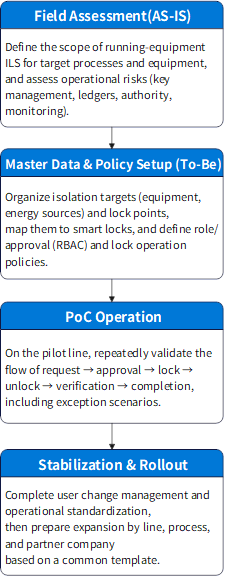
8-Week Standard Roadmap (Cloud / One Plant)
Customer Preparation Checklist
- Scope: plant, line, and target equipment (Operational ILS first)
- Roles & approvals: define administrators, supervisors, workers, and contractors
- Master data: initial list of equipment, energy sources, and isolation points
- Operating policy: lock issuance, return, loss, exceptions, and emergency rules
- App delivery: enterprise distribution, MDM, or app store
- Reporting requirements: including audit and incident investigation needs
Now is the time to turn field LOTO into an execution system.
Smart ILS is an execution-focused solution designed so the entire field workforce, including both direct employees and contractors, can perform LOTO under the same standard.
It connects master data, authorization (RBAC), operating policy, lock control, and automatic logs to structurally reduce missed steps and unauthorized handling in the field.
In particular, VLock restricts UNLOCK and RESTORE until ALL SAFE is confirmed, helping reduce restore-stage risk when personnel are still in the area.
Deployment can start with an 8-week cloud-based standard roadmap, and then expand step by step from running-equipment ILS to shut-down procedures based on proven field success.